
What Is a Business Immersive Event?
A business immersive event is an intensive, multi-day experience that pulls entrepreneurs and business leaders out of their day-to-day operations and places them in a structured environment designed for deep thinking, strategic planning, and actionable execution.
Unlike a one-day seminar or a weekend workshop, a business immersive is built around continuity. The work compounds across each day, with each session building directly on the progress made before it. The result is real momentum — the kind that’s hard to manufacture in a few hours.
Across America, these events are increasingly seen not as a “nice-to-have” but as a core growth accelerator. Business leaders from solopreneurs to mid-market executives are choosing them as the fastest path from stuck to unstuck.

Business Immersive Events vs. Traditional Formats
Before diving into the day-by-day breakdown, it’s worth understanding what sets a business immersive event apart from more familiar formats.
| Format | Duration | Depth | Outcome | Best For |
|---|---|---|---|---|
| Webinar / Online Course | 1–4 hrs | Surface-level | Knowledge | Learning concepts |
| Weekend Workshop | 2 days | Moderate | Ideas + some strategy | Inspiration & networking |
| Business Immersive (3-Day) | 3 days | Deep & applied | Actionable plan + execution | Growth breakthroughs |
| Mastermind (ongoing) | Monthly | Moderate | Accountability + peer insight | Long-term accountability |
Research consistently shows that multi-day immersive learning environments outperform shorter formats when it comes to behavior change and real-world application. A study published in the Journal of Applied Psychology found that spaced, intensive learning — rather than single-session training — leads to significantly better retention and implementation rates.
If you’re weighing your options, it’s also worth reading this detailed comparison: 3-Days Business Immersives VS. Weekend Workshops — it breaks down the structural differences and what to look for when evaluating an event.
A Day-by-Day Breakdown of a Business Immersive Event
Here’s what a well-designed, 3-day business immersive event actually looks like — hour by hour, outcome by outcome.
Day 1: Clarity, Diagnosis, and Foundation
Getting Clear Before Getting Busy
What participants typically say after Day 1: “I’ve been so focused on the day-to-day that I hadn’t realized how far I’d drifted from what I actually want to build.”

Day 2: Strategy, Decisions, and Execution Planning
From Clarity to Strategy
Day 3: Systems, Accountability, and Integration
Locking It In and Moving Forward
What Types of Business Immersive Events Exist in America?
Not all immersive events are structured the same way. Here are the most common formats you’ll encounter:
- Industry-specific immersives: Tailored to sectors like healthcare, real estate, e-commerce, or professional services. The peer group is curated around shared industry context.
- Stage-specific immersives: Designed for a particular business stage — startup founders, seven-figure operators, or teams scaling past $10M.
- Role-specific immersives: Focused on a specific function — marketing, leadership, operations, or sales.
- General growth immersives: Broader events that focus on the entrepreneur or business owner as a whole, addressing strategy, mindset, and execution across all business areas.
The Sprint Business Immersive Event Experience is designed as a comprehensive growth immersive — working across strategy, execution, and accountability — suitable for established business owners ready to move past growth plateaus.
Key Benefits of Attending a Business Immersive Event
Here’s what participants consistently report as the most significant outcomes:
- Accelerated clarity: Decisions that might take weeks or months to reach get resolved in days, because the environment removes distraction and adds expert perspective.
- Peer-level accountability: Being surrounded by other serious business owners creates a form of social accountability that online programs and solo reading simply can’t replicate.
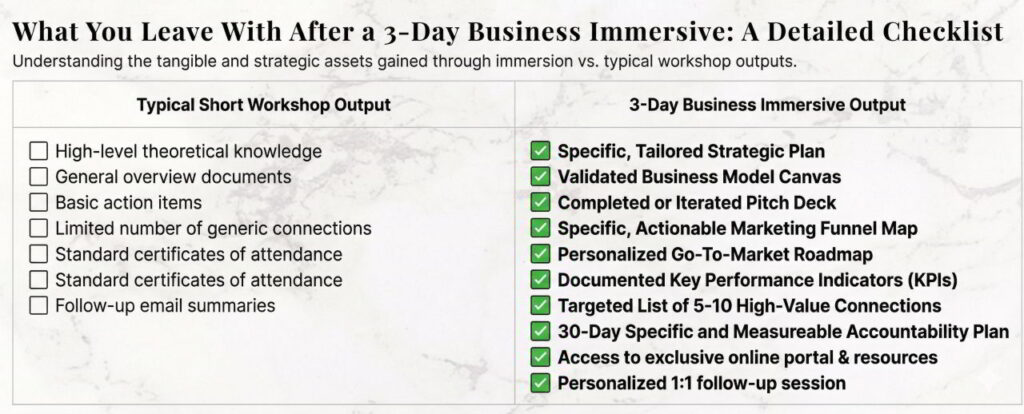
- Concrete deliverables: Unlike conferences where you leave with pages of notes, immersive events typically produce a specific, written plan — a sprint roadmap, a prioritized action list, or a revised business model.
- Expert facilitation: Quality immersives are led by experienced facilitators who have built and scaled businesses themselves. The difference between a facilitator and a speaker is execution credibility.
- Momentum that carries forward: The multi-day structure means you enter implementation mode before you leave, reducing the “Sunday night fade” common after weekend workshops.
What to Look for When Choosing a Business Immersive Event in America
Not every immersive event delivers equal results. Here are the factors that separate high-value experiences from expensive conferences with a different name:
Facilitator credentials and experience
Look beyond speaking credentials. Has the facilitator actually built and operated a business? Do they have a methodology — or are they improvising? Ask for a detailed agenda before you commit.
Cohort size and curation
Smaller groups allow for the depth of engagement that makes immersives work. Events with 100+ participants tend to function more like conferences. Look for events capped at 20–30 participants, or smaller if possible.
Structure vs. flexibility
The best immersives are tightly structured — with protected time for implementation, not just presentation. If the agenda is primarily keynotes and panels, it’s a conference, not an immersive.
Post-event support
What happens after day three? Do you have access to follow-up coaching, a community, or accountability check-ins? The highest-ROI events don’t end when you walk out the door.
Venue and environment
The physical environment matters more than most people expect. An off-site, distraction-minimized venue signals that the organizer understands what depth of work actually requires.
Is a Business Immersive Event Right for You?
Business immersive events are not for everyone — and that’s a feature, not a bug. They tend to deliver the highest ROI for:
- Business owners generating $500K–$5M in revenue who have hit a ceiling they can’t break through alone
- Entrepreneurs who have been “meaning to work on the business” but keep getting pulled into working in the business
- Leaders who’ve taken courses and hired coaches but haven’t translated knowledge into consistent execution
- Teams or founders preparing for a significant strategic shift — new market, new offer, new structure
If you’re still in early-stage mode with limited runway, a lower-cost online program may be a better first step. But if you’re past the validation stage and ready to scale — or ready to simplify and protect your margins — an immersive event is worth serious consideration.
Frequently Asked Questions
Conclusion: What You Actually Walk Away With
The honest answer to “what happens at a business immersive event?” is this: a lot more than you expect, and in less time than you’d think possible.
Day one strips away the noise and gives you clarity. Day two turns that clarity into strategy and specific decisions. Day three translates decisions into systems and commitments. By the time you leave, you have a plan — not a notebook full of ideas, but an executable, accountable, peer-reviewed plan.
That’s the difference between attending a business immersive event and attending almost anything else. The format is designed for output, not just input.
If you’re evaluating whether this type of experience is right for your business, start by exploring the Sprint Business Immersive Event Experience — a structured, results-oriented program designed specifically for business owners who are ready to move from strategy to execution.