
Multi-day business events are a significant commitment. Between registration fees, travel, accommodation, and time away from your business, the total cost—financial and opportunity—can easily run into the thousands of dollars. That makes the question a reasonable one: Is this actually worth it?
The answer is not a simple yes or no. It depends entirely on what you’re evaluating. Some events are transformational. Others are expensive networking lunches padded with motivational content. Knowing the difference before you book your flight is what this guide is designed to help you do.
What Makes a Multi-Day Business Event Different?
Not all professional development events are created equal. A one-day seminar, a weekend workshop, and a three-day business immersive all occupy different rungs on the depth-of-impact ladder.
The core advantage of a multi-day format is compounding learning. When structured correctly, each day builds on the previous one. Concepts introduced on Day 1 are applied on Day 2, then stress-tested in real-world scenarios on Day 3. That’s a fundamentally different experience from attending a single event where information is delivered and then left to you to interpret on your own.
Research in adult learning—specifically the spacing effect studied extensively in cognitive psychology—confirms that information retained over multiple sessions with application and reflection produces deeper, longer-lasting behavioral change than single-session learning. A well-designed 3-day format leverages this directly.
“The question is never just ‘how long is the event?’ It’s ‘how much of me leaves different than when I arrived?'”
Types of Multi-Day Business Events in America
Understanding what category an event falls into helps you set the right expectations—and ask the right questions before registering.
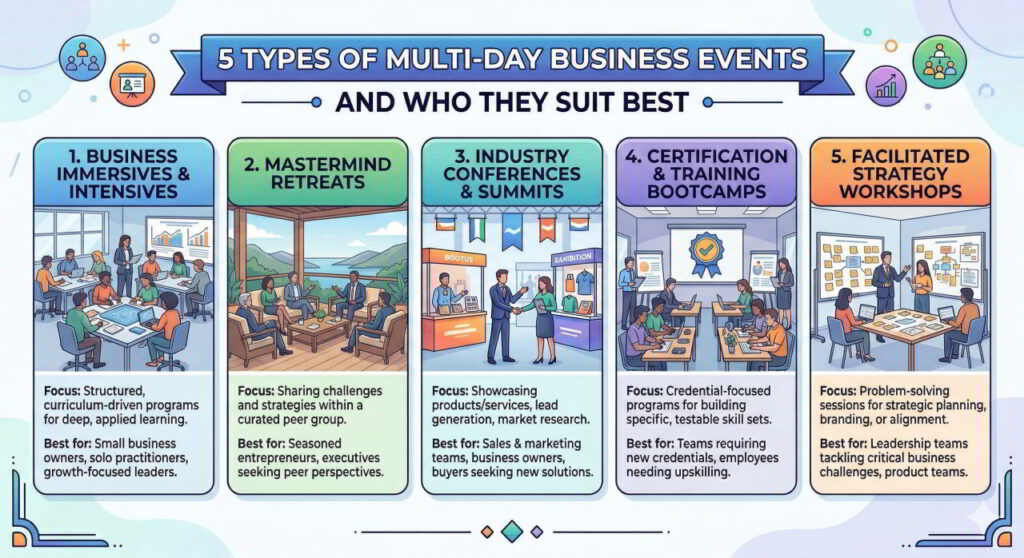
1. Business Immersives and Intensives
These are structured, curriculum-driven programs that typically span two to four days. The goal is deep, applied learning in a specific area: business strategy, sales systems, leadership, revenue growth, or operational scaling. The best examples are cohort-based and interactive, not lecture-heavy.
2. Mastermind Retreats
These bring together a curated group of business owners or executives to share challenges and strategies. Value is heavily peer-driven. The quality of who is in the room matters as much as who is at the front of it.
3. Industry Conferences and Summits
Broad, multi-track events covering industry news, keynote speakers, and breakout sessions. Great for networking and trend awareness. Weaker on implementation and accountability.
4. Certification and Training Bootcamps
Credential-focused programs designed to build a specific, testable skill set. Common in sales, marketing, leadership, and operations. These are well-suited to employees needing structured upskilling.
5. Facilitated Strategy Workshops
Smaller, facilitated sessions designed to solve a specific business problem—often strategic planning, brand positioning, or team alignment. Typically more expensive per head but highly focused on tangible deliverables.
The True Cost of a Multi-Day Business Event
Before evaluating ROI, you need an honest accounting of what you’re actually spending. Most people undercount.
- Registration fee — the most obvious cost, often ranging from $500 to $10,000+ for premium immersives
- Travel and accommodation — flights, hotel, transportation, and incidentals
- Meals and incidentals — often underestimated for multi-day events
- Opportunity cost — revenue, client work, or decisions put on hold while you’re away
- Team coverage — if your business needs someone to hold the fort while you’re gone, that has a cost too
For a typical American business owner attending a mid-tier 3-day immersive, total real costs—including opportunity cost—often range from $3,000 to $8,000. That’s the number your ROI calculation needs to beat.
Key Factors to Evaluate Before You Commit
These are the criteria that separate events worth attending from expensive distractions.
1. Curriculum Structure and Depth
Ask for a detailed agenda before registering. A strong multi-day event will show you exactly what will be covered, in what order, and why the sequence matters. Vague agendas that promise “transformational content” without specifics are a warning sign.
The best programs publish a clear learning map. If a 3-day business immersive event can show you a day-by-day breakdown with concrete outcomes for each session, that’s a strong signal of a well-engineered program.
2. Facilitator Expertise and Credibility
Who is running the sessions—and what have they actually built or done? A facilitator with real-world operating experience is different from someone who primarily teaches rather than does.
Look for evidence of practitioner expertise: companies founded or scaled, measurable results achieved with past clients, and testimonials that reference specific outcomes rather than vague praise.
3. Peer Quality and Cohort Curation
In a multi-day setting, you learn as much from the room as you do from the stage. Ask how the organizers curate attendees. Is there an application or vetting process? Are participants at a similar stage of business to you?
An event that accepts anyone who pays the registration fee will produce a less valuable peer experience than one with deliberate cohort selection.
4. Outcome Commitments
What, specifically, will you leave with? Strong programs can articulate outcomes: a strategic plan, a revenue model, a 90-day action plan, a refined sales framework. Weak programs describe experiences rather than outputs.
5. Implementation Support After the Event
The most common failure mode of professional development events is what happens—or doesn’t—in the weeks after. Ask whether the event includes any post-event accountability structures: follow-up calls, a community, check-in processes, or resource libraries.
Without implementation support, even the best content has a half-life of a few weeks.
6. Social Proof with Specificity
Testimonials are expected. What you’re looking for are testimonials that describe specific results: “I closed $80,000 in contracts within 60 days of attending” is more credible than “This event changed my life.” Look for outcome-specific case studies on the event’s website or review platforms.
| Evaluation Factor | Strong Program | Weak Program |
|---|---|---|
| Agenda | Detailed, sequenced, outcome-mapped | Vague, topic-list only |
| Facilitator credentials | Demonstrated practitioner results | Speaker bio only, no operational proof |
| Peer selection | Curated or application-based | Open enrollment, no criteria |
| Deliverables | Specific outputs you leave with | Experience described, no tangibles |
| Post-event support | Community, calls, or accountability | None mentioned |
| Testimonials | Outcome-specific with metrics | Emotional, generic praise |
| Business model | Content-first, upsell minimal | Heavy upselling within event |
3-Day Immersives vs. Weekend Workshops: Understanding the Difference
A common point of confusion is whether a 3-day immersive is simply a longer weekend workshop. They’re structurally different in ways that matter.
Weekend workshops (typically Saturday–Sunday) are compressed by necessity. Facilitators have to choose between breadth and depth, and there’s no time for overnight processing—the kind of reflection that makes learning stick.
A well-designed 3-day immersive uses the structure differently. Day 1 establishes foundations and surfaces the real constraints holding a business back. Day 2 goes deep on strategy, tools, and systems. Day 3 is focused entirely on application, planning, and accountability structures that survive re-entry into normal business life.
For a detailed look at why this format consistently outperforms shorter events, 3-day business immersives vs. weekend workshops is a useful comparative resource.
Benefits of Investing in a Well-Designed Multi-Day Business Event
1. Condensed Progress
Three focused days of strategic work can produce the kind of clarity and momentum that typically takes months of scattered coaching sessions. Immersion creates conditions for breakthroughs that incremental learning does not.
2. Peer Network Quality
Your professional network is one of your most valuable long-term business assets. A well-curated business immersive puts you in the room with peers who are working through similar challenges—creating relationships that often outlast the event by years.
3. Accountability Architecture
Unlike reading a business book or watching an online course, a live multi-day event creates social accountability. You make commitments in front of people. That changes follow-through rates significantly.
4. Perspective Shifts That Are Hard to Access Alone
Business owners and executives are often too close to their own operations to see what’s limiting them. Structured immersive experiences are specifically designed to create the conditions for perspective shifts—the kind that produce strategic pivots rather than incremental adjustments.
5. Implementation Velocity
The best programs don’t just teach strategy—they build the plan alongside you. Leaving an immersive with a specific 90-day roadmap, financial model, or operational blueprint compresses your implementation timeline dramatically.
Red Flags: Signs an Event May Not Be Worth It
These signals suggest an event may be structured more around sales than substance—regardless of the price tag.
- No detailed agenda available before registration — if they won’t tell you what you’re buying, that’s intentional
- Heavy upselling embedded in the event content — when the “training” is designed to funnel you into a higher-tier program, the event itself is the marketing
- No post-event community or accountability — the best programs know retention requires structure
- Testimonials with no specifics — “life-changing” is not a measurable outcome
- Speaker-heavy, workshop-light — if every session is a keynote presentation, you’re at a conference, not an immersive
- No vetting or cohort curation — open enrollment events tend toward the lowest common denominator
- Refund policy buried or absent — legitimate programs stand behind their product
How to Calculate Expected ROI Before You Register
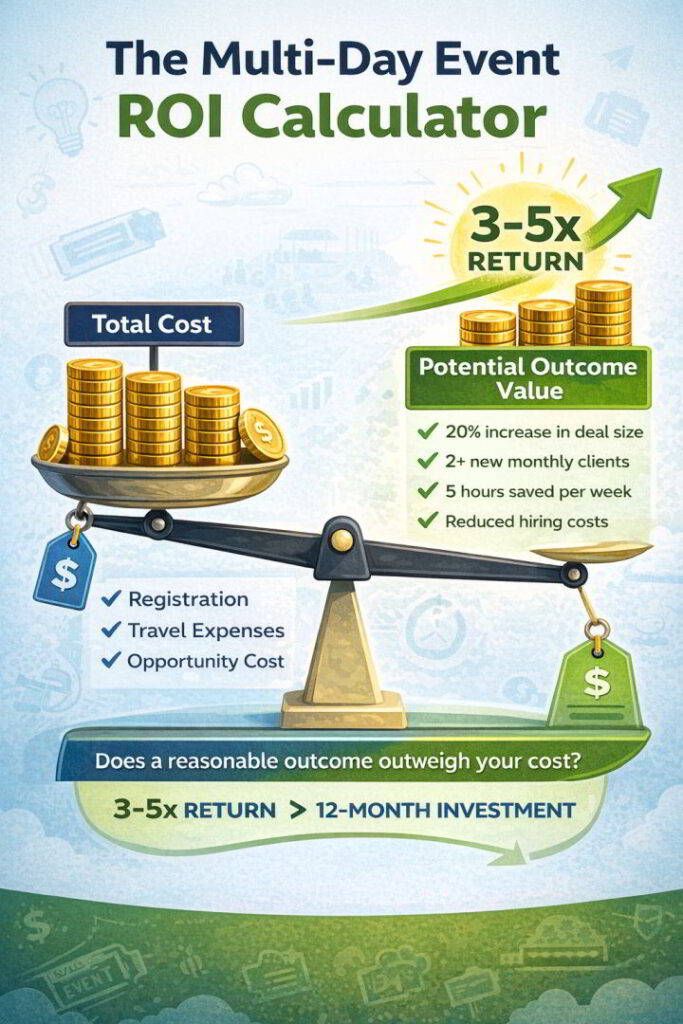
This doesn’t have to be complex. Start with a simple question: What would a single meaningful outcome from this event be worth to my business?
Examples of meaningful outcomes:
- A revised pricing strategy that increases average deal size by 20%
- A referral system that generates two additional clients per month
- An operational change that recovers 5 hours per week of your time
- A hiring framework that reduces bad hires—and the cost of turnover
Now compare that potential value to your total cost (registration + travel + opportunity cost). If a reasonable outcome would return 3–5x your investment within 12 months, the math usually works.
The risk isn’t the event—it’s attending an event that isn’t designed to produce those outcomes. That’s why vetting the program rigorously before committing matters so much.
What to Look for in a High-Quality 3-Day Business Immersive in America
As the market for business events has grown in the United States, so has the variance in quality. Here’s what distinguishes the top tier.
- A published, detailed 3-day curriculum with learning objectives per session
- Facilitators with verifiable operating experience—not just speaking or coaching credentials
- A deliberate cohort selection process (application, screening call, or qualification criteria)
- Tangible deliverables you build during the event—not just frameworks explained to you
- A post-event structure: community access, accountability calls, or a resource library
- Outcome-specific testimonials with business context and measurable results
- A clear, accessible refund or satisfaction policy
The SPRINT Experience was built to be worth every hour—and the program structure reflects that commitment. It’s a useful benchmark when evaluating how other 3-day immersive formats are organized and what they actually deliver.
American Market Context: Why Business Events Are Thriving
The professional development market in the United States is one of the largest in the world, valued at over $23 billion annually according to IBISWorld industry data. Within that market, in-person multi-day events have seen a strong resurgence post-pandemic—partly because remote-only development proved, for many business owners, to be a poor substitute for the depth and accountability of live, immersive programs.
American business owners and executives tend to have high expectations for return on investment. That cultural disposition is actually a useful filter: the best events in this market are designed around tangible, measurable outcomes—because that’s what the audience demands.
Frequently Asked Questions
How do I know if a multi-day business event is legitimate?
Look for a detailed public agenda, verifiable facilitator credentials, specific outcome-based testimonials, and a clear refund policy. Legitimate programs are transparent about what you’ll receive and stand behind it.
What is a reasonable price to pay for a 3-day business immersive in America?
Quality immersives in the U.S. typically range from $1,500 to $7,500 for registration, depending on cohort size, facilitator expertise, and included materials. The registration fee alone doesn’t predict quality—program structure does.
Is a 3-day business event better than ongoing coaching?
For many business owners, a well-designed 3-day immersive produces faster momentum than months of weekly coaching—because immersion creates conditions for compounding insight and real-time implementation. The two aren’t mutually exclusive; many people use an intensive as a catalyst, then use coaching to maintain progress.
What’s the difference between a business immersive and a conference?
A conference is primarily informational and networked—speakers present, attendees listen and meet. A business immersive is structured around application: you work on your business during the event, not just learn about business. The output is a plan or deliverable, not just notes.
How do I prepare to maximize the ROI of a multi-day business event?
Come with a specific challenge or decision you need to resolve. Review any pre-work materials thoroughly. Set aside distractions—delegate or pause client commitments during the event days. Block time in the week after to implement what you’ve built before the momentum fades.
What should I ask the event organizers before registering?
Ask for a detailed agenda, a description of who typically attends and how cohorts are selected, what tangible outputs participants leave with, and what support exists after the event ends. If they can’t answer those questions clearly, that’s important information.
Can I deduct the cost of a business event as a tax expense in the United States?
In many cases, yes—education and professional development expenses that maintain or improve skills required in your current business may be deductible. Consult a CPA or tax advisor to confirm eligibility under current IRS guidelines, as individual circumstances vary.