

The Real Cost of a Weekend Workshop
Let’s be honest…
you’ve probably done the workshop thing before.
You showed up. You took notes. You felt inspired.
And then Monday came…
and nothing actually changed.
It’s not the speakers or the content … it’s the format. The “traditional” workshop is fundamentally broken.
You spend a Saturday and Sunday consuming dense frameworks, leaving Sunday night exhausted and overstimulated. Monday morning hits, and the notebook gets filed. The insights that felt life-changing at 3 PM on day two evaporate by Wednesday.
Six months later, nothing has changed.
And this isn’t just a feeling… Research from the Harvard Business Review and multiple organizational psychology studies confirm that single-burst training events produce minimal long-term behavioral change without structured follow-through and spaced learning. The problem isn’t motivation – it’s neurobiology.
“Skill acquisition requires not just instruction but repeated retrieval, application under realistic pressure, and sleep-mediated memory consolidation – all of which take more than 48 hours.”
This is exactly why the growing movement toward 3-day business immersives in America is more than a trend. It’s a structural fix to a decades-old problem in professional development.
What the Extra Day Actually Does
The difference between a 2-day workshop and a 3-day immersive isn’t just time – it’s architecture. Each day serves a distinct neurological purpose.
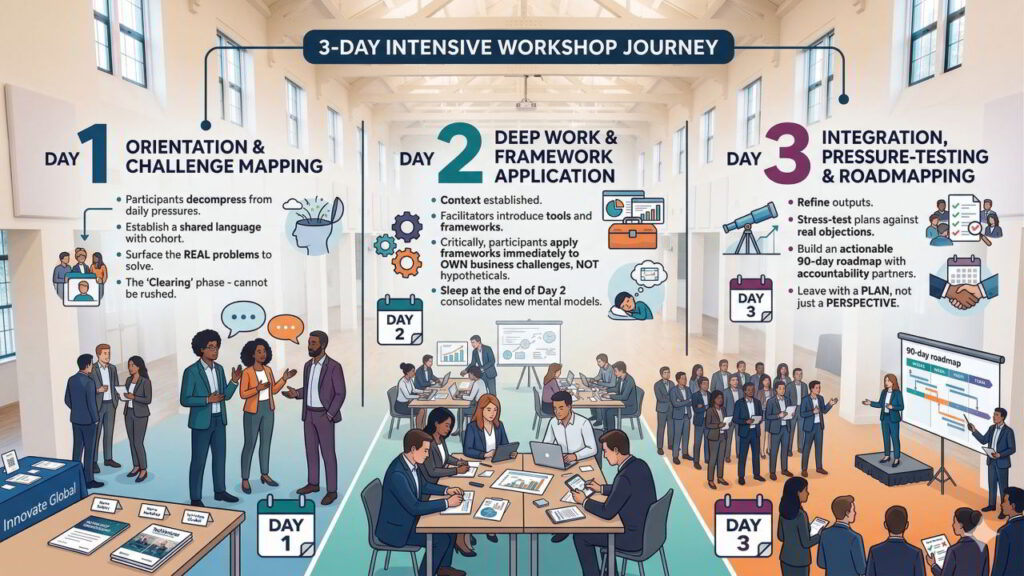
Day 1: Orientation & Challenge Mapping
Participants decompress from daily pressures, establish shared language with their cohort, and surface the real problems they need to solve. This “clearing” phase is rarely possible in a one-day sprint and cannot be rushed.
Day 2: Deep Work & Framework Application
With context established, facilitators introduce tools and frameworks. Critically, participants apply these frameworks immediately to their own business challenges – not hypothetical case studies. Sleep at the end of Day 2 consolidates these new mental models.
Day 3: Integration, Pressure-Testing & Roadmapping
This is the day that weekend workshops simply don’t have. Teams refine their outputs, stress-test their plans against real objections, and build an actionable 90-day roadmap with accountability partners. They leave with a plan, not just a perspective.
This is exactly why SPRINT was designed the way it is.
Not as another event.
But as a room where what you’ve been building finally starts moving.
Types of Business Immersives Available in America
Not every 3-day program is an “immersive” in the meaningful sense. Understanding the different formats helps you evaluate what you’re actually buying.
1. Leadership Immersives
Designed for founders, executives, and senior managers navigating growth or transition. These programs focus on decision-making frameworks, organizational design, and leading through uncertainty. Strong leadership immersives include psychometric tools, 360 feedback integration, and peer coaching structures.
2. Strategy Sprint Immersives
Built for teams that need to solve a specific strategic problem – a market pivot, product launch, or operational challenge – in compressed time. The Sprint Experience model pioneered this format, drawing from Google Ventures’ Design Sprint methodology and adapting it for broader business strategy contexts.
3. Sales & Revenue Growth Immersives
Intensive programs focused on pipeline development, pricing strategy, objection handling, and conversion optimization. These work best when cohorts include participants from similar growth stages rather than mixing enterprise executives with early-stage founders.
4. Culture & Team Performance Immersives
Whole-team experiences focused on communication, psychological safety, and high-performance team dynamics. These often incorporate experiential learning, facilitated challenges, simulations, and outdoor components, rather than purely didactic instruction.
5. Industry-Specific Immersives
Vertical-specific programs designed for tech, healthcare, real estate, professional services, or other sectors. The advantage is shared vocabulary and sector-relevant case studies; the risk is insular thinking without cross-industry perspective.
3-Day Immersives vs. Other Learning Formats: A Direct Comparison
Before committing budget and time, it helps to understand how immersives stack up against the alternatives American professionals typically consider.
| Format | Duration | Deep Skill Transfer | Peer Community | Implementation Support | Cost Range |
|---|---|---|---|---|---|
| Online Course | Self-paced | Low–Medium | Rarely | None | $50–$2,000 |
| Weekend Workshop | 2 days | Low–Medium | Limited | Rare | $500–$5,000 |
| Conference / Summit | 2–4 days | Low | Strong | None | $500–$3,000 |
| Executive MBA Module | 1 week+ | High | Strong | Moderate | $5,000–$30,000 |
| 1:1 Business Coaching | Ongoing | High | None | Strong | $500–$3,000/mo |
| 3-Day Business Immersive | 3 days | High | Strong | Built-in | $2,000–$15,000 |
The 3-day immersive sits in a unique value position: it delivers the depth of one-on-one coaching and the community of a conference, while including the implementation structure that online courses and weekend workshops consistently lack.
What to Look for in a 3-Day Business Immersive
Quality varies enormously in this space. A well-designed immersive can reshape how you run your business. A poorly designed one is an expensive distraction. Here are the eight factors that separate genuinely transformative programs from overpriced retreats.
Proven Curriculum Architecture
Ask to see a detailed day-by-day agenda. Look for a learning arc – orientation, application, integration – not just a topic list. Avoid programs that front-load content and skip implementation.
Facilitator Credentials & Experience
Your lead facilitator should have real operating experience, not just training certifications. Look for demonstrated business building, not just keynote speaking credits.
Cohort Curation
Who else will be in the room matters as much as the facilitator. Programs that selectively curate cohort size (typically 12–25 participants) and business stage will generate better peer learning than open-enrollment events.
Application Over Theory
At least 40–50% of structured time should involve working on your actual business challenges, not listening to presentations or consuming case studies.
Post-Event Accountability Structures
The best immersives build in 30, 60, and 90-day follow-up mechanisms, whether group calls, accountability partner assignments, or continued community access. Verify these exist before enrolling.
Clear Success Metrics
What specifically will you have at the end of Day 3? A 90-day roadmap? A defined growth strategy? A solved product challenge? Vague promises of “transformation” are a red flag.
Verified Testimonials & Case Studies
Request specific outcome data from previous participants’ revenue growth, hires made, and strategies launched. Generic “life-changing” testimonials without business specifics are insufficient evidence.
Appropriate Group-to-Facilitator Ratio
For deep work to happen, facilitators need capacity for individual attention. Ideal ratios are 1 facilitator per 8–12 participants. Larger ratios typically produce lecture-heavy formats, not immersive experiences.
Key Benefits of a Well-Designed Business Immersive
When the format is right, the returns on a 3-day business immersive go well beyond what you’ll learn in a classroom or online course. Here are the five most consistently reported outcomes among American business leaders who participate.
- Accelerated decision-making clarity. Immersive environments remove daily operational noise, creating the mental space for leaders to tackle decisions they’ve been postponing. Many participants report resolving months-long strategic ambiguities within the first two days.
- High-quality peer relationships. The compressed, high-intensity environment of a 3-day immersive creates stronger professional bonds than months of networking events. These peer relationships become ongoing advisory relationships, referral networks, and business partnerships.
- Concrete deliverables, not just insights. Participants leave with tangible outputs – validated strategies, documented plans, refined pitches – rather than a notebook full of ideas they may never revisit.
- Accountability infrastructure. The cohort and facilitator relationships established during an immersive create natural accountability structures that extend post-event. This is the single biggest driver of implementation follow-through.
- Renewed operational energy.
Due Diligence: Protecting Your Investment
The professional development space in America is largely unregulated. Unlike licensed therapy or accredited education, anyone can run a “business immersive.” This makes due diligence essential.
Questions to Ask Before You Enroll
- Can I speak with two or three past participants from my industry or business stage?
- What is the refund or cancellation policy if I need to withdraw?
- How is the cohort selected, and what criteria are used?
- What specific deliverable will I have at the end of Day 3?
- What are the facilitator’s qualifications and operating history?
- Is there a post-event community or follow-up structure, and at what cost?
- What is the group size, and how many facilitators will be present?
Red Flags to Watch For
- Heavy emphasis on motivational content without practical frameworks
- Vague outcomes (“you’ll be transformed”) without specific deliverables
- No transparency about cohort selection or composition
- Facilitators with only speaking/training backgrounds and no operating experience
- High-pressure enrollment tactics or manufactured urgency
- Testimonials with no specific, verifiable business outcomes
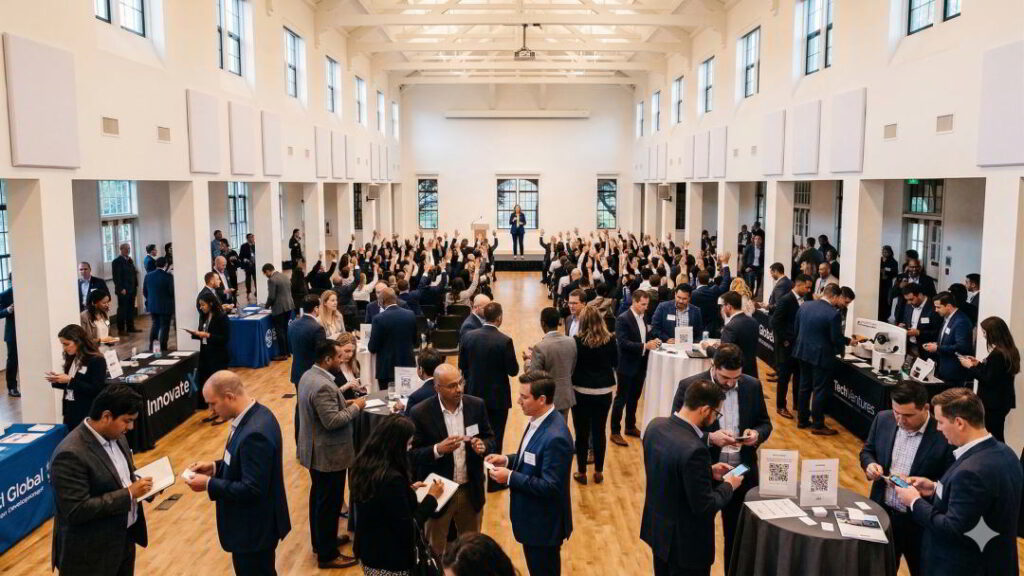
Why American Entrepreneurs Are Choosing Sprint-Format Immersives
The sprint methodology – originally developed for product teams at Google Ventures – has been adapted successfully for broader business strategy contexts. Its core principle is elegant: compress months of back-and-forth decision-making into a structured, time-boxed intensive where teams emerge with tested solutions, not just ideas.
Applied to business immersives, the sprint format produces a distinctive advantage: you don’t just learn frameworks, you produce outputs. By the close of Day 3, participants in well-run sprint-format programs typically have a validated strategy, a defined 90-day action plan, and a peer accountability structure to support execution.
For American business owners and leaders navigating growth, competitive pressure, and operational complexity, this format offers something rare: high-quality strategic thinking time that their daily schedules simply don’t allow.
Programs built on this model – like those offered through Three-Day Business Sprint Immersive Event Experience – combine structured sprint methodology with expert facilitation and curated cohort curation to produce consistent, measurable outcomes for participants across industries.
Frequently Asked Questions
These are the questions American professionals most commonly ask when evaluating business immersives for the first time.
From a well-designed program: a validated 90-day action plan for a specific strategic priority, 10–20 high-quality professional relationships, new frameworks applicable to your business model, and renewed clarity about your next moves. What you should not expect: immediate revenue returns from Day 4 onward, or transformation without disciplined follow-through implementation post-event.
The Bottom Line
The shift toward 3-day immersives isn’t about trends.
It’s about results.
Because learning without implementation is just information…
and information doesn’t move a business forward.
The right environment changes that.
When you have the space to think, the structure to apply, and the right people in the room, things stop feeling scattered… and start making sense.
You leave with more than ideas.
You leave with direction.
With decisions made.
With momentum already in motion.
And that’s the difference.
You can keep collecting insights…
or you can step into the room where everything starts working together.